

 En



Start & Stop of Linear Modules; Sample Vibration Interferes with Inspection Results? SMARTWIN Optimizes Motion Profile Solution
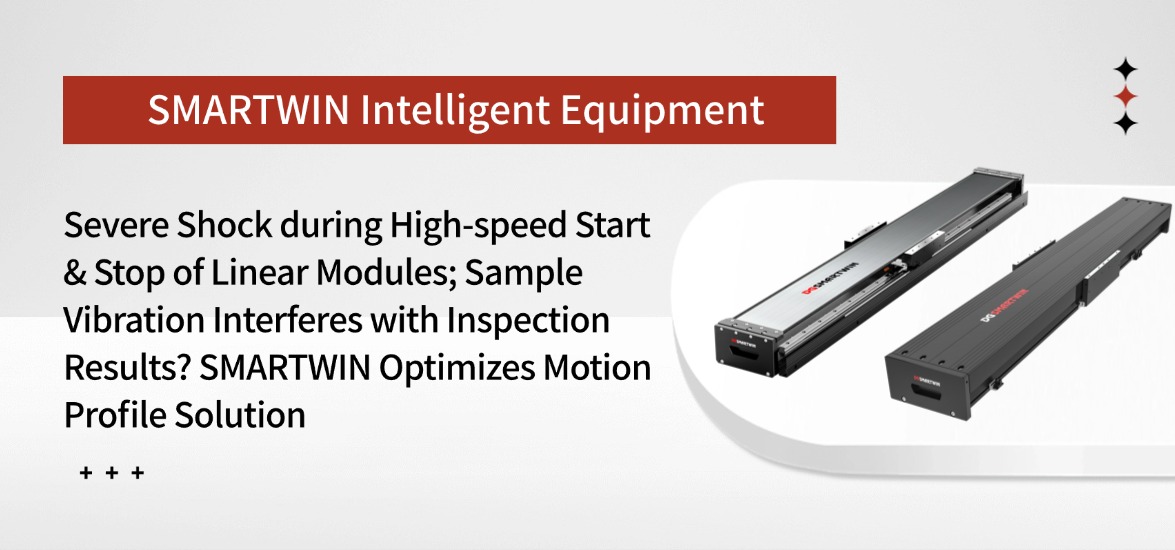
Start & Stop of Linear Modules; Sample Vibration Interferes with Inspection Results? SMARTWIN Optimizes Motion Profile Solution
During commissioning of medical and precision inspection automation equipment, shock and vibration induced by high-speed start-stop of linear modules are frequently encountered on-site. Many devices meet the static repeat positioning accuracy specification, yet inertial shock occurs at the moment of start and stop, causing samples and reagents on the carriage to shake. For highly sensitive processes such as microscopic scanning and micro-reagent testing, even slight vibration will result in blurred images and distorted test data.
Many engineers repeatedly tune controller parameters with limited improvement. The root cause usually lies in insufficient rigidity of the module itself and hardware incompatible with the motion profile required for precision working conditions. Drawing on abundant project implementation experience, SMARTWIN Intelligent Equipment carries out targeted optimization for linear modules to address shock and vibration issues during high-speed start and stop.
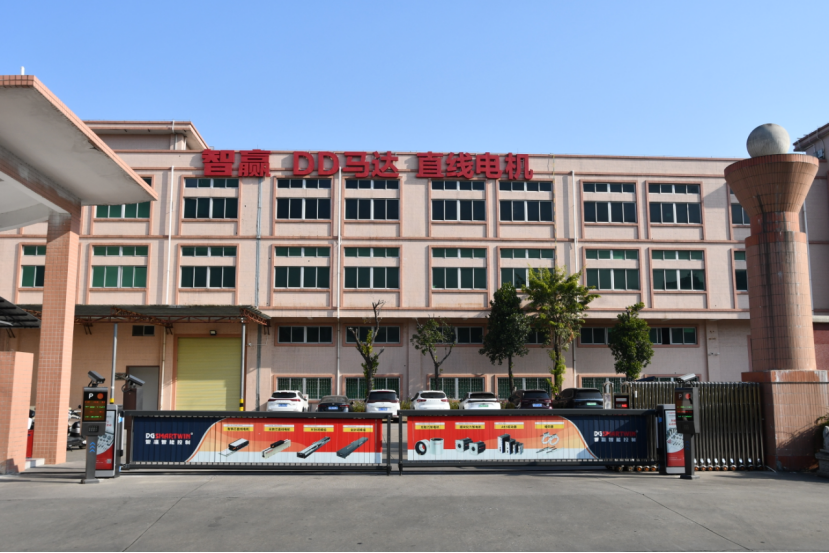
1. Insufficient Module Rigidity Aggravates Inertial Vibration During Start-Stop
Some economical linear modules adopt profile bases with low rigidity. When the slide carriage undergoes rapid acceleration or deceleration, slight deformation and vibration occur on the whole unit. No matter how controller parameters are tuned, such physical deformation vibration cannot be eliminated. Especially when sample fixtures are mounted on the carriage and the load changes, shaking induced by start-stop shock will be further amplified.
For sample scanning and transfer applications, ultra-high maximum speed is not required, yet stringent smoothness of motion is demanded. Insufficient rigidity of the module body transmits start-stop shock directly to samples on the carriage. SMARTWIN linear modules adopt high-rigidity profile bases and optimized internal transmission structures to enhance the unit’s deformation resistance and reduce physical vibration sources upon start and stop.
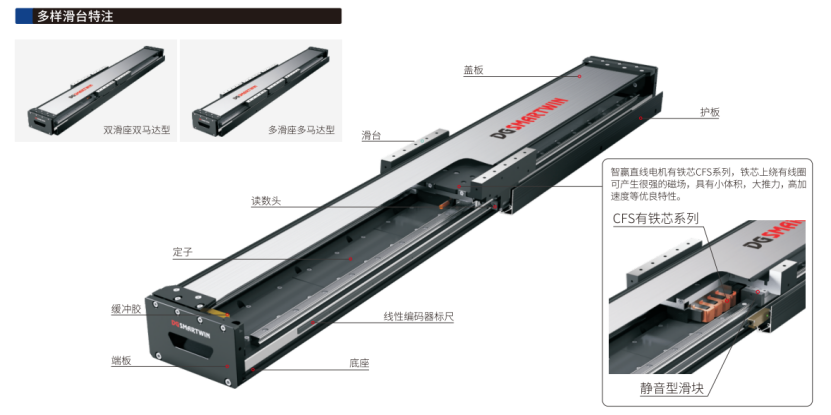
2. Mismatched Motion Profile for Precision Inspection Scenarios Results in Insufficient Shock Absorption
Many equipment adopt standard trapezoidal velocity profile directly. Steep variations during acceleration and deceleration lead to obvious shock. Although acceleration and deceleration time can be adjusted via the controller, simply extending such time will reduce the overall production cycle time, making it hard to balance efficiency and smooth motion.
For precision inspection and transfer applications, SMARTWIN provides hardware foundation compatible with S-curve flexible motion profiles. The transmission pair of the module features uniform running resistance. Combined with the controller, smooth transition of acceleration and deceleration can be realized. While maintaining production cycle time, shock at start and stop is reduced. The slide carriage stabilizes rapidly after reaching the target position, shortening the waiting delay caused by sample shaking, and balancing equipment efficiency and inspection stability.
Many equipment adopt standard trapezoidal velocity profile directly. Steep variation during acceleration and deceleration lead to obvious shock. Although acceleration and deceleration time can be adjusted via the controller, simply extending such time will reduce the overall production cycle time, making it hard to balance efficiency and smooth motion.
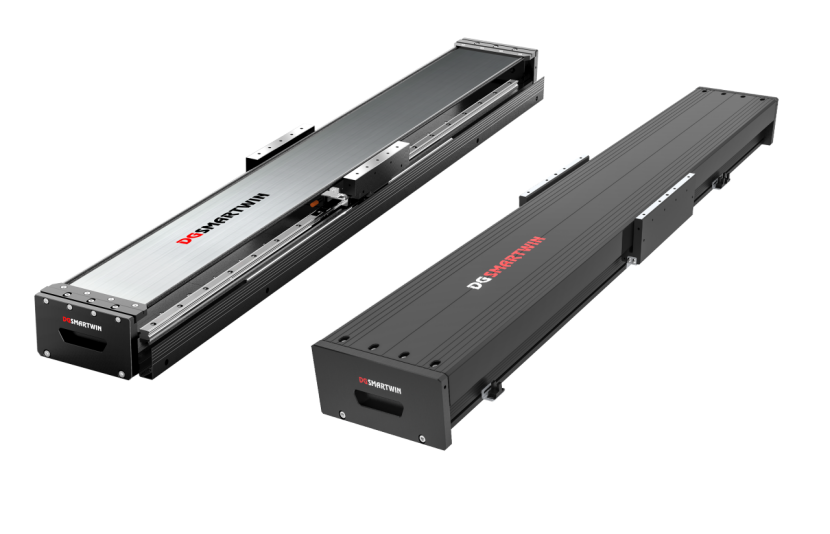
3. Working Condition Customization and Factory Running-in to Ensure Consistency of Batch Equipment
SMARTWIN Intelligent Equipment carries out module selection evaluation according to actual load, travel and cycle time requirements of equipment. Custom adaptation of slide carriage and transmission structure is available when necessary. Complete machine running-in is finished before delivery to bring transmission pairs into a stable friction state and reduce vibration risks of new units after installation. In one medical inspection equipment project, optimized linear modules effectively mitigate sample shaking during transfer and guarantee image quality for microscopic scanning.
Q: Repeated controller parameter tuning brings limited improvement. Where may the problem lie?
A: Controller parameters can only provide dynamic compensation and cannot eliminate inherent defects of the mechanical body. If tuning after multiple rounds achieves unsatisfactory results, focus on two hardware checks: first, insufficient overall rigidity of linear module, bearing support and load mounting structure, which causes deformation and resonance during motion; second, mismatching between inherent dynamic characteristics of the system and motion profiles such as acceleration/deceleration and positioning under working conditions. To solve the issue fundamentally, optimization shall start from module structure and load mounting scheme.
SMARTWIN Intelligent Equipment carries out module selection evaluation according to actual load, travel and cycle time requirements of equipment. Custom adaptation of slide carriage and transmission structure is available when necessary. Complete machine running-in is finished before delivery to bring transmission pairs into a stable friction state and reduce vibration risks of new units after installation. In one medical inspection equipment project, optimized linear modules effectively mitigate sample shaking during transfer and guarantee image quality for microscopic scanning.