

 En
En



How to Solve the Challenge of Micro-Workpiece Transfer in Cleanrooms? SMARTWIN Linear Modules Adapt to Semiconductor Packaging and Inspection Equipment
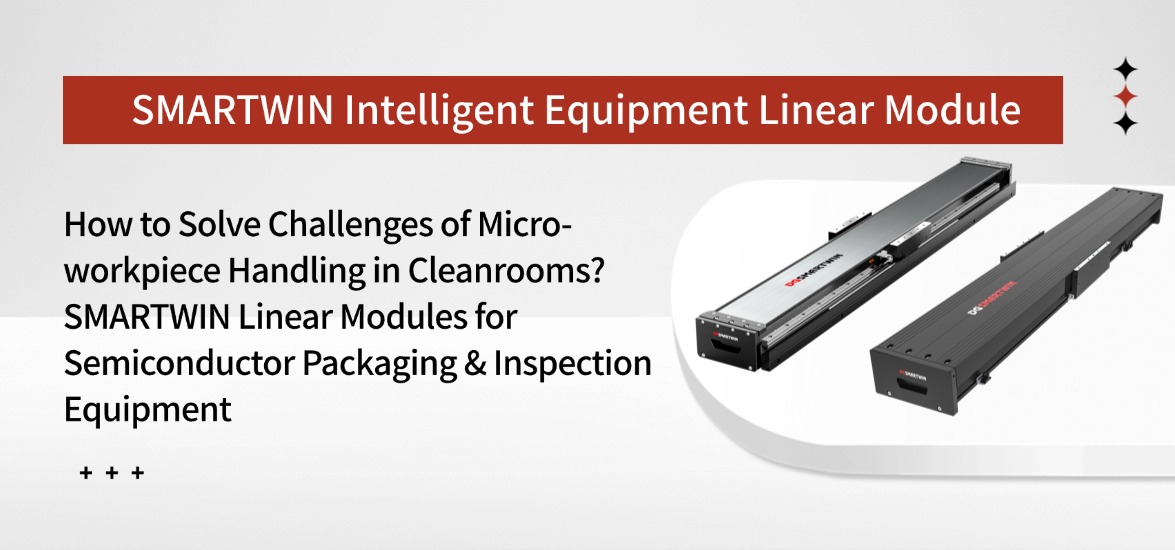
How to Solve the Challenge of Micro-Workpiece Transfer in Cleanrooms? SMARTWIN Linear Modules Adapt to Semiconductor Packaging and Inspection Equipment
I. Operating Characteristics of Semiconductor Back-End Packaging & Inspection
For packaging, visual inspection and sorting processes of semiconductor components, workpieces are tiny and impose stringent requirements on dust protection rating and positioning accuracy of motion mechanisms. The workshop is a clean environment; moving parts must not generate particulate contamination on wafers and chips. Transfer motion also needs to be smooth to avoid displacement or damage of microchips.
Engineers developing semiconductor back-end equipment are well aware that some components at chip sorting stations are smaller than rice grains. Slight deviation in suction force or transfer acceleration will cause component ejection or lead pin deformation. Cleanliness requirements pose an even greater challenge: in ISO Class 5 or higher-grade workshops, a single metal particle shed from worn guide rails falling onto a wafer may result in scrappage of an entire batch of materials. Many equipment manufacturers struggle to balance tact speed and cleanliness, only to find the bottleneck lies in the motion axis.
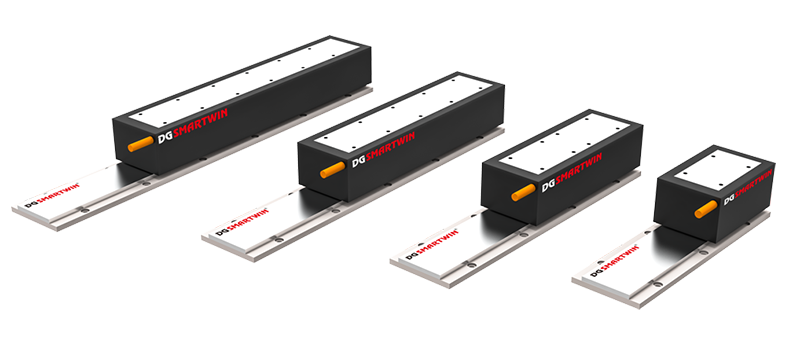
SMARTWIN linear modules can be equipped with optional dust-tight sealing structures to reduce debris generated by internal friction. Rather than simply adding a dust cover and marketing it as a cleanroom-grade product, we select each component complying with semiconductor workshop particulate control standards, covering guide rail sealing type, slide material and lubrication method. Low-wear mating pairs are adopted for internal friction interfaces, and cleanroom-certified grease is used to minimize shedding particles during high-speed reciprocating operation.
In a chip sorting equipment project for a domestic semiconductor packaging equipment enterprise, SMARTWIN linear modules are deployed at microchip pick-and-transfer stations to realize smooth workpiece handling and positioning, compatible with cleanroom production environments. The acceleration / deceleration profile for pick actions, buffer segment for nozzle descent, and velocity fluctuation during transfer are integrated into one unified control logic, ensuring vibration-free transfer and no rebound upon landing. Chips are ready for immediate imaging once they reach the inspection station.
II. For Microchip Transfer, Start-Stop Timing Directly Determines Tact
Sorting and visual inspection in semiconductor back-end processes run with tact measured in seconds or even milliseconds. A single station can process two to three components per second, amounting to throughput of hundreds of thousands of chips daily. If the transfer axis fails to execute crisp start-stop motion, delayed acceleration or extra vibration during deceleration will drag down the tact of the entire line.
SMARTWIN linear modules take "clean start-stop" as a hard specification for micro-workpiece transfer, delivering full closed-loop response and zero-contact wear. What chip sorting stations require is "no wobble when picking, precise stop upon arrival, immediate departure after placement", with no residual vibration transmitted to components.
At the commissioning stage, SMARTWIN performs bound tuning of drive parameters, encoder resolution, pick cycle and axis motion timing. S-curve acceleration and deceleration is not merely a simple parameter setting; proper jerk values are derived from component weight, nozzle inertia and transfer distance. This enables the slide table to complete start and stop within the shortest time without imposing impact on end components. Equipment manufacturers do not need to guess profile settings. Before delivery, the displacement trajectory of components during transfer is captured by high-speed cameras in the test workshop, and shipment is only approved after verification of zero component ejection.
III. Customization Capability for Compact Precision Linear Modules
The cramped internal space inside semiconductor equipment is a universal pain point for all system integrators. Test machines are packed with power supplies, light sources, cameras, lenses and nozzle mechanisms, leaving only a narrow strip of space for motion axes. Standard modules fail to fit, while custom designs entail long lead times and hold up project delivery.
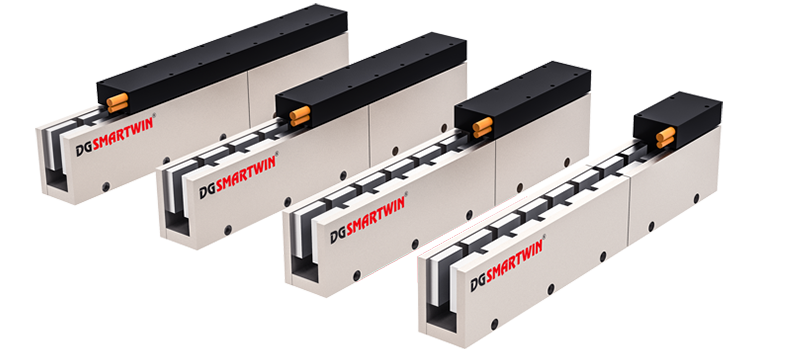
SMARTWIN supplies slim linear modules that deliver precise linear motion within confined spaces. Custom mounting holes and limit switch positions are supported to adapt to compact internal machine structures. Instead of requiring customers to modify their machines to fit standard products, we tailor module geometry to match the machine’s internal footprint: narrow base, thin slide table, and sensor slots relocated to side or end faces, with every millimeter carefully optimized.
Space constraints become even tighter for multi-axis stacking and gantry inspection stations, making axis interference checking a meticulous task. SMARTWIN adopts a practical approach for such compact layouts: module dimensions, mounting tolerances, cable routing and sensor placement are all evaluated during the solution design phase. 3D models are shared in advance, and interference checks are completed digitally before shop assembly. This prevents integrators from discovering a two-millimeter fit mismatch only after physical hardware arrives.
When production lines switch component specifications, such as modified pick pitch, transfer travel or inspection station layout, slide mounting surfaces, sensor slots and cable carrier routing can be confirmed in advance. Combining SMARTWIN’s hardware customization capability with DGSMARTWIN motion control adaptation, risks including spatial interference, travel margin and positioning accuracy can be eliminated at the sample stage. Semiconductor equipment has long validation cycles; every issue resolved at the prototype phase reduces rework during mass production.
IV. Full-Lifecycle Technical Service Support
SMARTWIN is well-versed in the development workflow of automated precision equipment and provides end-to-end technical support covering preliminary solution selection, sample testing and mass production delivery. The biggest concern for semiconductor equipment manufacturers is not module procurement, but lack of after-delivery support from suppliers: who to contact for precision degradation, who takes responsibility for cleanroom grade non-compliance, and who performs tuning when tact fails to rise during mass production ramp-up.
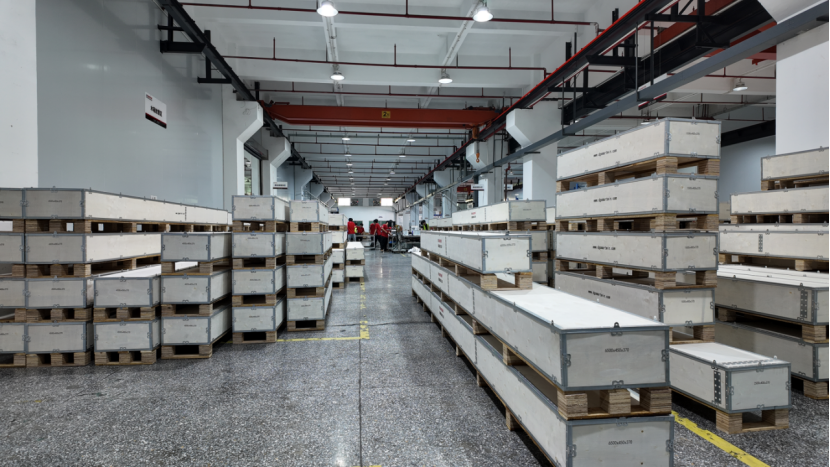
Each SMARTWIN linear module deployed for semiconductor applications is configured to match specified cleanroom classes, delivered with precision inspection reports and dust resistance performance statements. Inspection is not merely token sampling. Every unit is tested on the inspection bench. Positioning accuracy, repeat positioning accuracy and backlash are scanned across the full stroke, with archived traceable data. Batch consistency serves as a mandatory requirement for bulk delivery in mass production: modules from the same batch must exhibit no significant precision dispersion when installed in dozens of machines.