

 En
En



When Does a CKM150 Linear Motor Make Sense for Heavy-Load Motion?
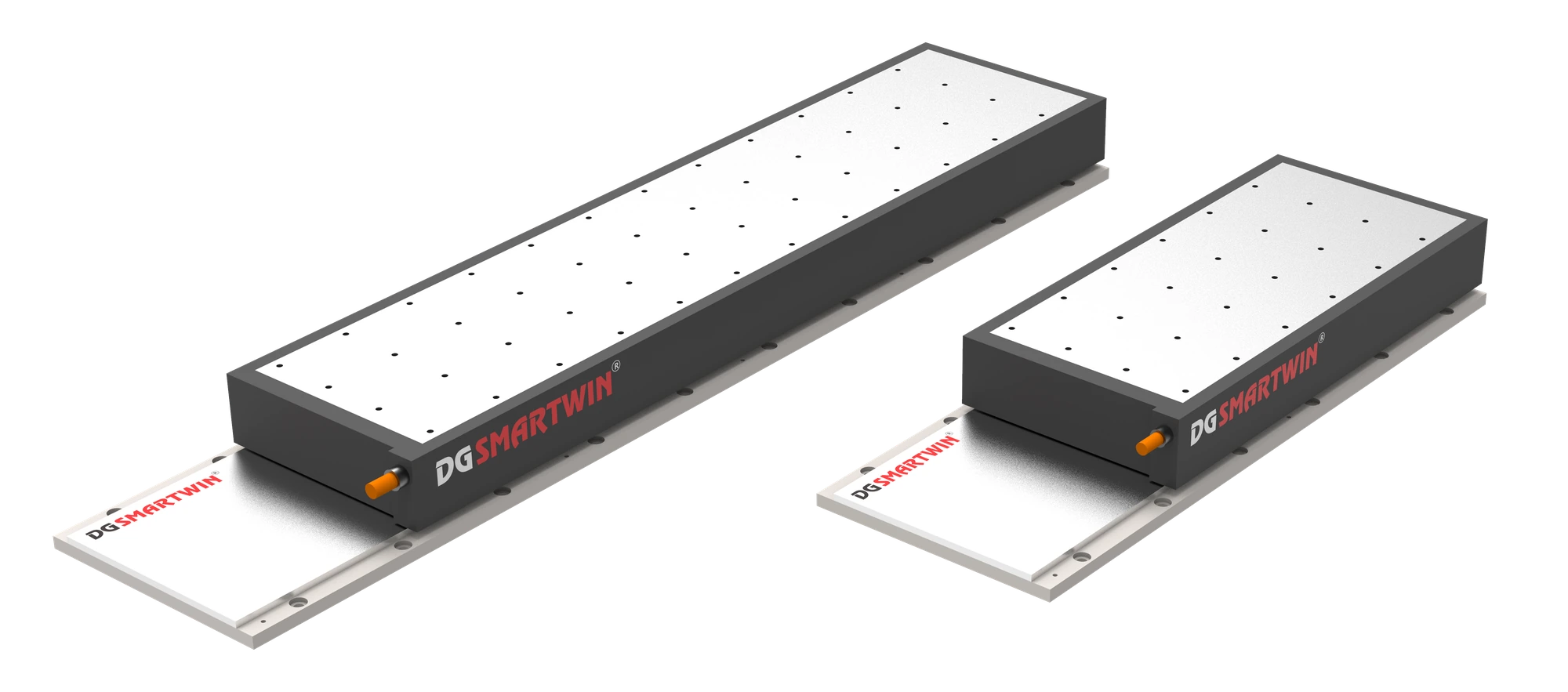
This article explains when the CKM150 linear motor makes sense for heavy-load motion and what factors should be considered before selection.
Heavy Load Means More Than Payload for a High Thrust Linear Motor
A common mistake in linear motor selection is to calculate motor size from the workpiece weight alone. In practice, the motor has to move the entire axis assembly, including the stage, fixtures, tooling, sensors and cable carriers.
For example, a 150 kg workpiece may be only part of the total moving mass. Once the supporting structure and attached components are included, the actual load seen by the motor can be significantly higher.
The motion profile matters just as much as the mass itself. A heavy stage moving at a steady pace may require moderate force, while rapid acceleration, short stopping distances and frequent cycling can push the thrust demand much higher.
A simple starting point is:
Acceleration force = total moving mass × acceleration
This is why payload weight alone cannot determine whether a high thrust linear motor is necessary. Accurate sizing starts with the full moving mass, followed by the speed, acceleration and cycle requirements of the axis.
When Does a CKM150 Linear Motor Make Sense for Heavy-Load Motion?
There is no fixed payload threshold that automatically means an axis needs CKM150. The choice usually depends on several factors working together, including moving mass, acceleration, duty cycle and the amount of force margin required by the system.
1.Large Moving Mass
CKM150 becomes a stronger option when the moving assembly is too heavy for a smaller motor to handle comfortably. This is often seen in large positioning stages, panel handling systems, semiconductor equipment and other machines carrying substantial tooling or fixtures.
The important question is whether the motor can move the complete assembly at the required speed and acceleration without operating too close to its limits.
2.High Acceleration with Heavy Loads
A heavy axis does not always require very high thrust if the movement is relatively slow. Force demand rises much more quickly when the same mass must accelerate rapidly, stop within a short distance and repeat the motion at a high cycle rate.
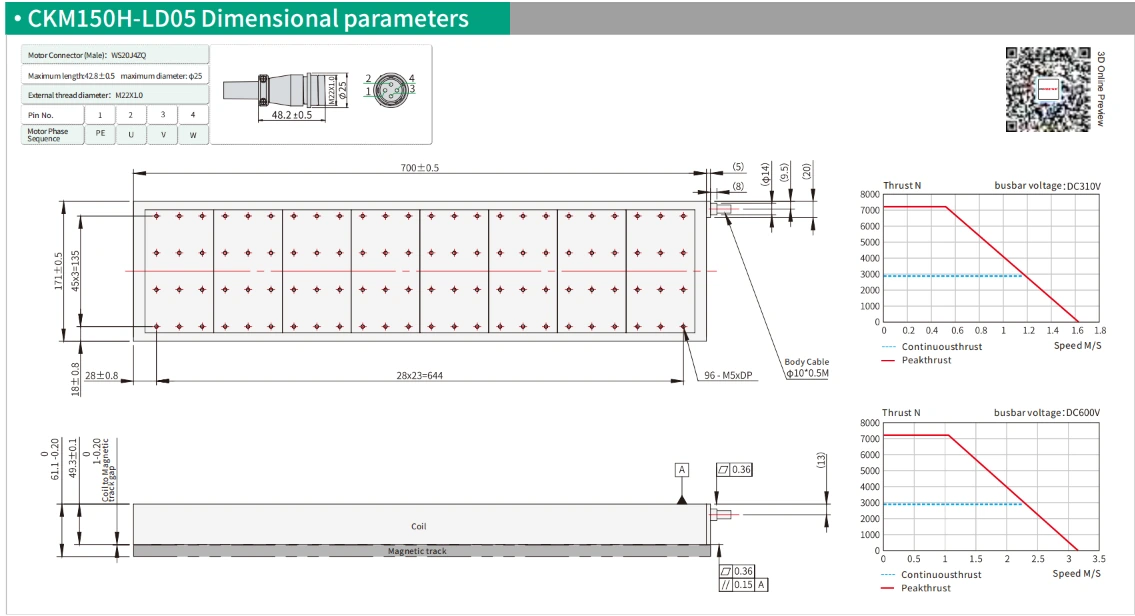
In these conditions, a high thrust linear motor can provide more useful force margin. The CKM150D delivers about 2146 N continuous thrust and 4777 N peak thrust, while the CKM150H reaches about 4293 N continuous thrust and 9553 N peak thrust.
3.High Continuous Force Demand
Some axes need high force only during acceleration, while others remain heavily loaded through much of the operating cycle.
If the motor spends too much time near its continuous-force limit, relying mainly on peak thrust during selection can create thermal problems and reduce operating margin. The complete duty cycle therefore needs to be considered, not just the highest force value.
4.Long Production Cycles
Short test runs do not always reflect how an axis will behave during continuous production. With repeated cycles and limited cooling time, heat gradually becomes a more important factor in sustained performance.
For this type of application, the CKM150 linear motor becomes more relevant when high force must be maintained over extended operating periods. Moving mass, acceleration, continuous force and cycle time should all be reviewed together before the final motor selection.
Hidden Loads That Affect Heavy Load Linear Motor Sizing
Sizing a heavy load linear motor is rarely as simple as adding up the payload weight. Once the axis is built, several less obvious forces begin to matter, and some of them change as the machine moves through its stroke.
1.Fixtures and Tooling
The motor carries everything mounted on the moving stage, not just the workpiece. Large fixtures, vacuum plates, inspection heads or processing tools can add considerable mass, especially on equipment designed around rigid tooling.
This becomes more important when tooling is changed later. A heavier fixture may look like a minor modification, but it can reduce the force margin that was available in the original design.
2.Cable Carrier Drag
Cable chains and hoses are easy to overlook because they are not part of the main load calculation. During motion, however, they bend, pull and create resistance along the stroke.
The effect is usually more noticeable on long-travel axes. Resistance can also change with position, so the motor may see a higher load in one part of the stroke than another.
3.Mechanical Resistance
Direct drive removes many transmission components, but it does not make the axis mechanically frictionless. Guide preload, alignment, seals and bearing condition still influence how easily the stage moves.
A rail system that is slightly misaligned, for example, can create extra resistance without changing the nominal payload at all. If that resistance is ignored, the motor may operate closer to its limit than expected.
4.Process Forces
Some axes are not only moving parts from one position to another. They may also be pushing, pressing, dispensing or holding against an external force during part of the cycle.
These loads are often intermittent, which makes them easy to miss during early sizing. Even so, they can have a direct effect on peak force and on how much margin the motor needs during actual production.
5.Vertical Motion
Gravity changes the calculation for a vertical axis. The motor is not only responsible for acceleration and positioning; it may also need to support the moving mass continuously.
That makes continuous force more critical than it is on many horizontal axes. Depending on the machine design, a brake or counterbalance system may also be needed to reduce load on the motor and improve safety.
Once these additional forces are included, an axis that initially looked moderate may fall into a much higher force range. That is where a CKM150 high thrust linear motor becomes worth considering—not simply because the payload is heavy, but because the complete mechanical system demands more sustained force.
Why Guide Rails Matter as Much as the CKM150 Linear Motor
Because CKM150 is an iron-core motor, its guideway must withstand not only the moving load but also the magnetic attraction between the armature and magnet track. That additional normal force is carried directly by the rails and bearings.

On a heavy-load axis, an undersized guide system can become a limitation before motor thrust does. Excessive bearing load, narrow rail spacing or poor alignment may introduce friction, uneven motion and faster wear.
Large fixtures and off-center loads add another challenge by creating pitch, yaw and roll moments during acceleration and braking. Rail spacing and structural stiffness therefore need to match the force level of the CKM150 installation.
The motor can provide the required thrust, but stable operation still depends on a guideway that can carry the load and maintain accurate motion throughout the stroke.
What Long Production Cycles Mean for the CKM150 Linear Motor
CKM150 may have enough thrust for a demanding move, but continuous production puts a different kind of pressure on the axis. Repeated acceleration, deceleration and holding force gradually increase motor temperature, especially when there is little cooling time between cycles.
This is why peak thrust alone is not enough when evaluating CKM150 for long-running equipment. The more useful reference is how much force the motor must sustain across the complete cycle and how often that cycle repeats.
If the axis operates close to its continuous-force limit for extended periods, heat can reduce available performance and affect motion consistency. In this case, duty cycle, RMS force and cooling conditions should be reviewed before finalizing the motor selection.
For applications running through long production shifts, the CKM150 linear motor should therefore be sized with enough thermal and force margin, not simply enough thrust to complete a single move.
FAQ About CKM150 Linear Motor
1. What applications is the CKM150 linear motor suitable for?
CKM150 is better suited to heavy-load motion where the axis requires high thrust, fast acceleration or stable operation under demanding duty cycles. Typical uses can include large positioning stages, panel handling equipment, semiconductor machinery and other industrial systems carrying substantial moving mass.
2. How do I know whether CKM150 is too large for my application?
If the required force can already be met comfortably by a smaller motor with enough continuous-force and thermal margin, CKM150 may be unnecessary. Selection should be based on total moving mass, acceleration, cycle time and external forces rather than choosing the highest available thrust.
3. What is the difference between CKM150D and CKM150H?
The main difference is available thrust. CKM150D provides about 2146 N continuous thrust and 4777 N peak thrust, while CKM150H reaches about 4293 N continuous thrust and 9553 N peak thrust. The suitable version depends on the force profile and duty cycle of the axis.
4. Can CKM150 be used for vertical motion?
Yes, but vertical motion requires additional consideration because the motor must work against gravity. Continuous force, braking, counterbalance design and safety requirements should all be reviewed before using CKM150 on a vertical axis.
5. Does CKM150 require a specific guide rail system?
There is no single guide rail configuration for every CKM150 application, but the rails and bearings must be able to handle the moving load, magnetic attraction, acceleration forces and any pitch, yaw or roll moments generated by the machine structure.
6. What information is needed before selecting a CKM150 linear motor?
The most useful information includes total moving mass, stroke, target speed, acceleration, cycle time, mounting direction, external process forces and expected operating hours. These values make it easier to determine whether CKM150 provides the right force and thermal margin.
Conclusion
For a new machine or motion upgrade, Smartwin can help review your load, stroke, speed, acceleration and duty cycle to determine whether CKM150 is the right fit for the application.
Back To List