

 En



Rapid Accuracy Degradation of Fully Enclosed Linear Motor Modules in Dusty Environments? SMARTWIN Analyzes Protection Levels and Application Boundaries
Rapid Accuracy Degradation of Fully Enclosed Linear Motor Modules in Dusty Environments? SMARTWIN Analyzes Protection Levels and Application Boundaries
Workshops for photovoltaic and lithium battery production are filled with silicon powder and electrode dust. Many machines adopt fully enclosed linear motor modules, yet accuracy still drifts after a period of operation. Numerous customers assume full enclosure can completely isolate dust. In fact, fully enclosed protection has its application limits and cannot achieve absolute "zero ingress". Based on many field projects of SMARTWIN fully enclosed linear motor modules, we sort out failure causes under dusty conditions, and objectively clarify the protection boundaries and corresponding improvement measures.
I. The external sealing structure remains intact, yet gaps at cable entry/exit points cause leakage
Many customers tend to fall into a misunderstanding: a sealed housing means complete airtightness. Gaps exist on the bottom of the module, which can be observed from underneath. When the motor reciprocates at high speed, airflow disturbance is generated inside the cavity. Floating dust can easily be drawn into the cavity through these bottom gaps. The guide rail sliders are pre-lubricated, and the grease is adhesive by nature. Incoming dust readily adheres and accumulates on the rail assembly. This serves as the primary cause of accuracy degradation for modules operating in dusty environments. Mixed dust and grease form sludge, continuously altering the friction characteristics of sliders, resulting in fluctuating resistance and reduced preload, and eventually leading to positioning drift and poor repeatability. Besides, cable outlets and cover joint seams are secondary pathways for dust infiltration.
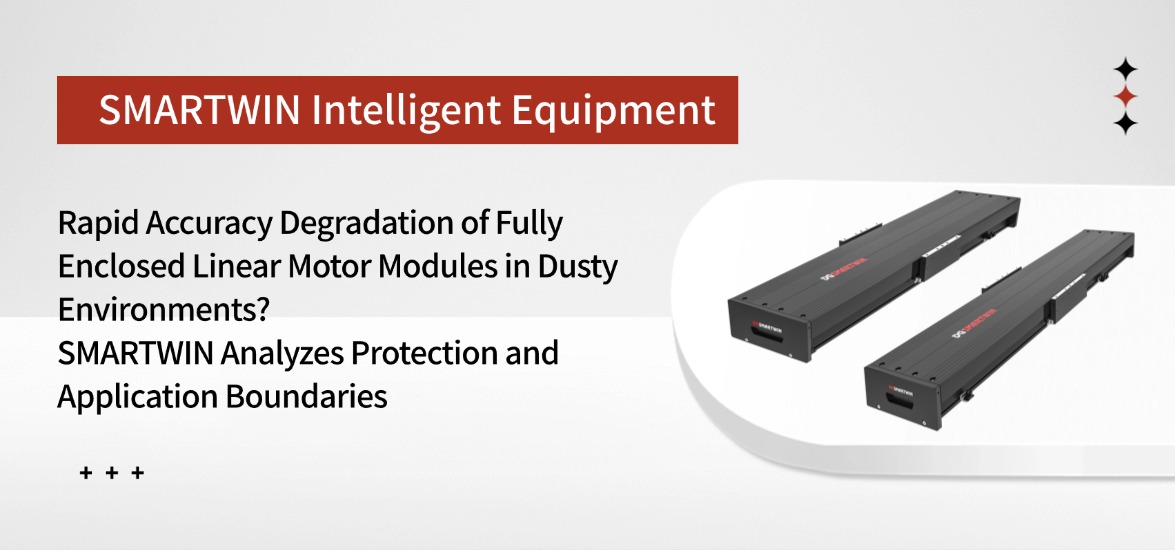
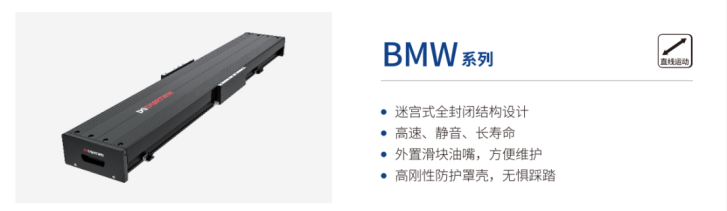
The housing of SMARTWIN BMW fully enclosed linear module is sealed. Meanwhile, we remind customers to pay attention to sealing solutions for cable outlets. For sites with extremely high dust concentration, in addition to the module’s own protection, the machine side shall implement proper sealing for cable feed-through holes to block secondary dust ingress paths.
II. Periodic maintenance and calibration are still required in dusty environments
It should be objectively understood that fully enclosed protection can greatly slow down dust ingress, yet it cannot achieve theoretically permanent and complete dust isolation. Even modules with favorable protection ratings require regular external cleaning and accuracy calibration when running 24 hours a day in high-concentration dust environments; zero maintenance is not achievable. Some customers expect the module to operate without any maintenance or long-term calibration after selection. Tiny dust accumulation on the grating surface will cause feedback errors, manifested as positioning accuracy drift. SMARTWIN clearly specifies the recommended maintenance cycle for dusty working conditions in technical documents, reminding customers to perform regular external inspections and accuracy re-verification.
Q: Does a fully enclosed linear motor module mean no dust can get inside?
A: No. "Fully enclosed" means the module adopts closed structures such as sealed housing, dust-proof steel strip and sealed end caps to block most dust and protect core moving components including gratings and guide rails. However, it is not zero-ingress protection. Tiny amounts of dust may still seep slowly through cable feed-throughs, sealing joints, worn dust belts and other locations. Supporting sealing measures and regular maintenance are required for heavy-dust applications.
Q: Is periodic maintenance still necessary for fully enclosed modules in dust workshops?
A: Yes. The fully enclosed structure greatly delays dust ingress but cannot block dust permanently, so zero maintenance is not available. Many customers select the module expecting long-term maintenance-free operation without accuracy calibration. In actual operation, slight dust accumulation on the grating will introduce feedback errors and lead to gradual positioning accuracy drift. By the time process abnormalities are detected, a batch of defective products may have already been produced. The maintenance cycle shall be determined according to on-site dust concentration and daily operating hours. Conditions with heavy dust and 24-hour continuous production differ greatly from ordinary workshops. It is recommended to take the cycle stated in technical documents as the baseline, and dynamically adjust it based on measured accuracy degradation data in the early stage. Embedding maintenance and accuracy recheck into the equipment check list delivers more stable and reliable results than relying solely on operator experience.