

 En
En



CFW090 Linear Motor for Fast, High-Force Motion: Is It Right for Your Machine?
This article explains how the CFW090 linear motor supports high-speed, high-force motion applications, and how to evaluate whether it is suitable for your machine.
Finding the Motion Bottleneck Before Choosing a CFW090 Linear Motor
A machine can already achieve high travel speed but still fail to meet the expected cycle time.
When we analyze these cases, the limitation is often found during acceleration and positioning.
For example, a transfer stage may move fast once it reaches speed, but the overall process is slowed down because the axis takes too long to accelerate the load or settle at the target position.
This is where a CFW090 linear motor can provide an advantage.
The direct-drive structure allows the motor to respond directly to motion commands, helping the axis achieve faster acceleration and more consistent movement during repeated cycles.
Before choosing a motor, we usually focus on a few practical questions:
How heavy is the moving load?
How quickly does the axis need to accelerate?
How often does the motion repeat?
Is the current limitation caused by force, speed, or cycle stability?
These answers determine whether a higher-force linear motor is needed.
CFW090 High-Speed Linear Motor for High-Force Motion
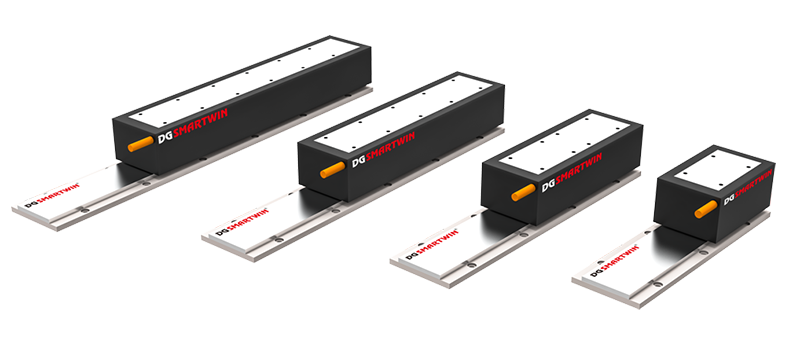
The CFW090 high-speed linear motor is designed for applications where compact size alone is no longer enough and the axis requires more available force.
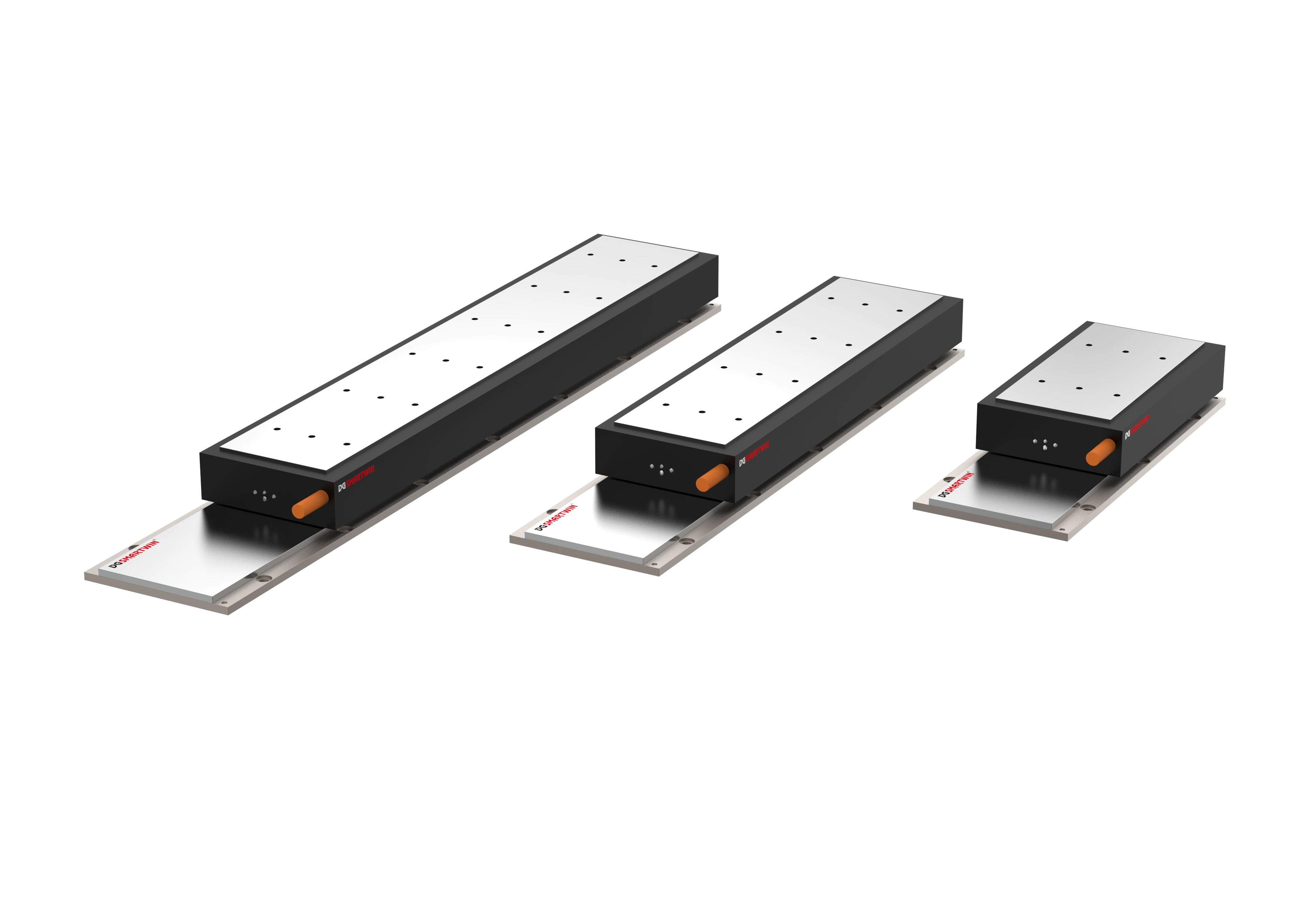
With a 114.5 mm armature width, CFW090 provides a higher-force platform for demanding automation systems.
The series includes different configurations:
When we select between these configurations, the decision is mainly based on the actual motion demand.
A lighter moving assembly may only require a lower-force configuration. For heavier fixtures, faster acceleration, or more frequent cycles, a higher-thrust model provides additional operating margin.
The purpose is not to choose the largest motor available. It is to find a configuration that matches the machine’s real working condition.
How CFW090 Linear Motor Handles High-Acceleration Motion
High acceleration is usually required when a machine needs to shorten the time between two working positions.
For example, in a high-speed transfer system, the moving stage may carry a fixture or multiple components. The challenge is not only reaching the target speed, but reaching that speed quickly while keeping the motion stable.This is where the thrust capability of CFW090 becomes important.
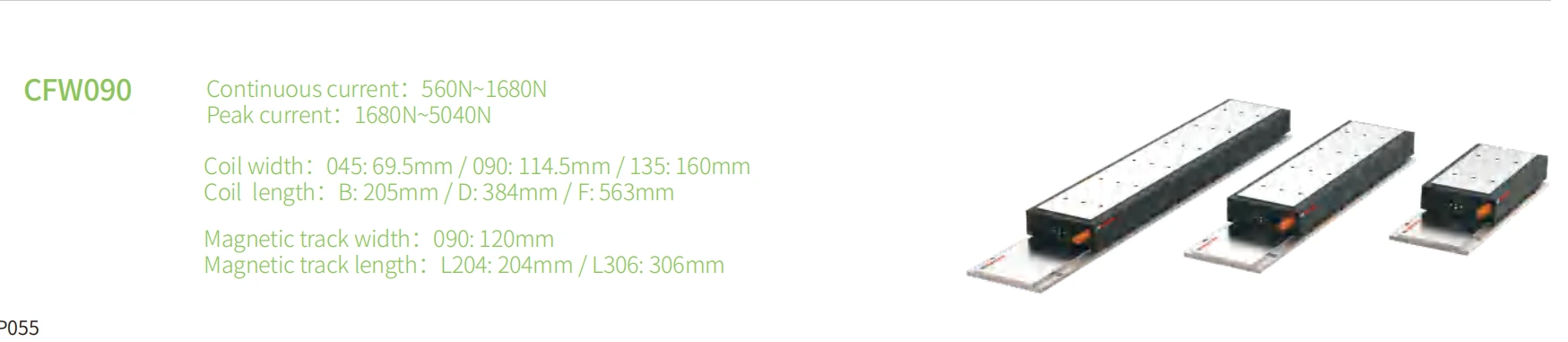
With continuous thrust options from 560 N to 1680 N and peak thrust up to 5040 N, the CFW090 provides more force margin for demanding acceleration profiles.
A higher-force configuration can help when:
The moving load is relatively heavy
The travel distance is short and acceleration time is limited
The machine requires frequent start-stop movements
Cycle time reduction is a priority
For a high-dynamic axis, insufficient thrust often means slower acceleration or longer settling time. Selecting a suitable CFW090 configuration allows the motor to deliver the required motion performance without continuously operating at its limit.
The selection should still be based on the actual machine cycle. A higher thrust model is valuable only when the application can make use of the additional dynamic capability.
Why Peak Thrust Is Not Enough for CFW090 Selection
The high peak thrust of CFW090 provides strong acceleration capability, but it does not represent the complete operating condition of the motor.
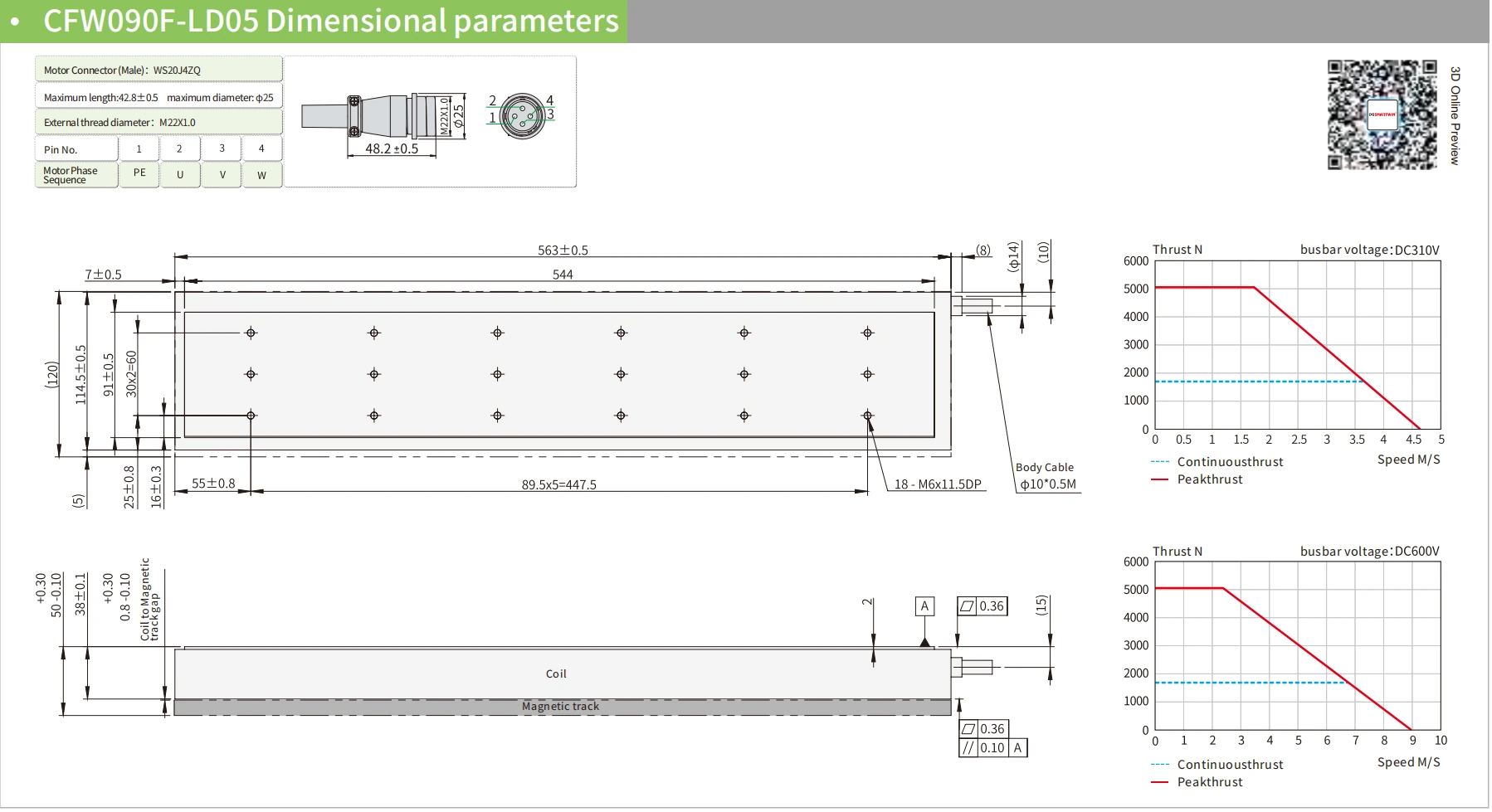
For example, the CFW090F reaches 5040 N peak thrust, which is useful when the axis requires rapid acceleration or needs to handle higher dynamic loads. However, this force level is only available during short periods of the motion cycle.
During actual production, the motor also operates through constant-speed movement, positioning, and repeated cycles. These conditions are mainly related to continuous thrust and thermal load.
The CFW090 series provides 560 N to 1680 N continuous thrust, giving different options for applications with different load levels and duty cycles.
A suitable configuration should provide enough peak force for acceleration while maintaining sufficient continuous capability for stable long-term operation.
Evaluating CFW090 Performance During Repeated High-Speed Cycles
For high-speed automation, maintaining consistent performance over long production periods is often more important than achieving a fast movement once.

Repeated acceleration, deceleration, and position changes gradually increase the thermal demand on the motor. As cycle frequency rises, the selected configuration needs to handle not only short-term force requirements but also continuous operating conditions.
Several factors need to be considered when applying CFW090 in repeated motion systems:
1.Continuous Load
The motor configuration should match the force demand throughout the normal production cycle.
A model that performs well during short testing may not be suitable if it continuously operates close to its limit.
2.Motion Frequency
Shorter cycle times usually increase the number of acceleration and deceleration events.
Higher motion frequency places greater demand on the motor’s continuous performance and thermal margin.
3.System Integration
The final motion performance depends on the complete axis design, including encoder feedback, servo tuning, mechanical structure, and control parameters.
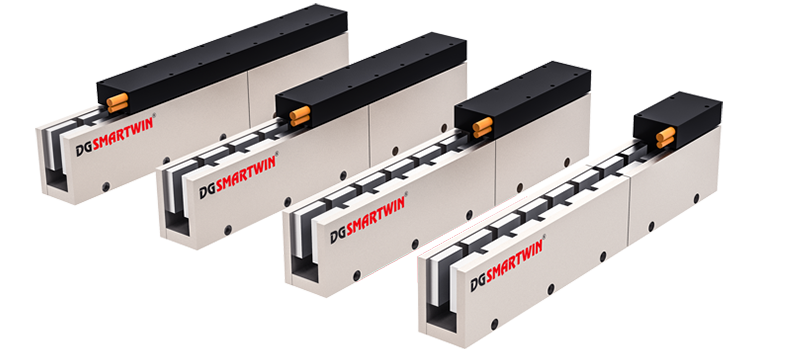
The CFW090 linear motor can be combined with the MFW090 stator system, with different stator lengths available to support various travel requirements.
A properly matched configuration allows the motor to deliver high dynamic performance while maintaining reliable operation during continuous production.
Conclusion
Selecting the right configuration requires evaluating the complete motion profile, including load, acceleration, continuous force, and duty cycle.

By matching the motor capability with the actual machine requirements, Smartwin helps engineers develop more efficient and stable linear motion solutions.
FAQ About CFW090 Linear Motor
1.What applications are suitable for the CFW090 linear motor?
The CFW090 linear motor is suitable for high-speed automation applications that require high thrust, fast acceleration, and stable repeated motion. It is commonly used for demanding motion axes such as transfer systems, inspection equipment, and precision automation platforms.
2.What is the difference between CFW090B, CFW090D, and CFW090F?
The main difference between CFW090 configurations is their thrust capability. CFW090B provides 560 N continuous thrust, while CFW090D and CFW090F increase the available force for heavier loads and more demanding motion cycles.
3.How much thrust can the CFW090 linear motor provide?
The CFW090 linear motor provides 560 N to 1680 N continuous thrust and up to 5040 N peak thrust depending on the selected configuration. The suitable model depends on the required acceleration, load, and duty cycle of the application.
4.Why is peak thrust not enough when selecting a CFW090 linear motor?
Peak thrust only represents the maximum short-term force during acceleration. CFW090 selection should also consider continuous thrust, duty cycle, and thermal performance to ensure stable operation during repeated production cycles.
Back To List