

 En



Optical Rotary Encoder


High precision
Multiple resolution options can meet different needs.

High motion speed
The encoder features high motion speed, capable of meeting high-speed demands.

Compact structure
Compact and space-saving design can meet, meeting space constraints.

Strong resistance to contamination
The encoder has excellent resistance to contamination, reducing the impact of the environment on its performance.


Optical Rotary Encoder FAQ
- Q:
What applications require a high-precision optical rotary encoder?
A: A high-precision optical rotary encoder is commonly used in equipment where accurate angular position feedback is important, such as precision rotary stages, inspection systems, semiconductor equipment, and automated positioning mechanisms.
These applications may require the controller to monitor small angular movements or maintain repeatable positioning during operation. The encoder should be selected according to the required angular accuracy, resolution, rotational speed, and available installation space rather than the application name alone. - Q:
How do you choose between the SHR04 and SAR23 rotary encoders?
A: The main difference between these SMARTWIN optical rotary encoder series is their position feedback method.
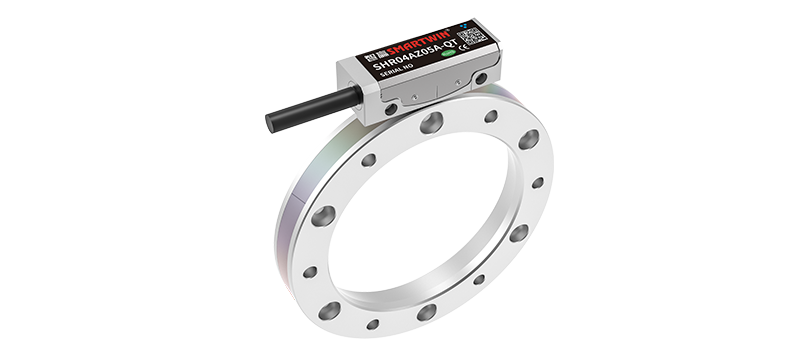
SHR04: An incremental circular grating encoder with ABZ differential output, suitable for systems that establish a reference position and track relative angular movement.
SAR23: An absolute circular grating encoder using the BiSS-C protocol, suitable for systems requiring absolute angular position feedback.
Choose the SHR04 when incremental feedback meets the control requirements. If the system needs absolute position information after power-up, consider the SAR23. Mounting dimensions, resolution, angular accuracy, and controller compatibility should also be reviewed. - Q:
What affects the positioning accuracy of an optical rotary encoder?
A: Angular positioning accuracy depends on the encoder's measurement characteristics and the mechanical conditions of its installation. Grating accuracy, readhead alignment, eccentricity, and mechanical runout can all influence the measured position.
For the SMARTWIN SAR23, positional accuracy depends partly on the circular grating diameter and the assembly relationship between the readhead and grating. Engineers should therefore review the encoder specifications together with the mounting drawings and alignment tolerances to achieve the expected measurement performance. - Q:
How does circular grating diameter affect optical rotary encoder selection?
A: Circular grating diameter influences the mechanical integration and measurement performance of an optical rotary encoder. A larger diameter provides more physical measurement length per revolution, but the actual angular accuracy depends on the grating design, readhead, and installation quality.
The SMARTWIN SAR23 series offers different circular grating diameter configurations. When selecting one, consider the available space around the rotary axis, the mounting structure, and the accuracy requirements. The chosen diameter must also be compatible with the corresponding readhead and installation specifications. - Q:
Is the SAR23 BiSS-C interface compatible with your motion controller?
A: The SMARTWIN SAR23 uses the BiSS-C communication protocol, so the controller must support a compatible BiSS-C encoder interface. However, protocol support alone does not guarantee full compatibility.
Before integration, verify the controller's electrical requirements, communication settings, position data format, connector wiring, and encoder power supply. Comparing the SAR23 datasheet with the controller documentation helps determine whether the selected configuration can be used without interface or signal compatibility issues. - Q:
What should you consider when installing an optical rotary encoder on a rotary axis
A: Start by checking the circular grating dimensions, mounting surface, readhead position, and specified scanning gap. The grating must be mounted concentrically with the rotary axis, while the readhead should maintain the required alignment throughout rotation.
Mechanical runout, installation tolerances, and cable routing also need attention. For separate readhead and grating configurations such as the SMARTWIN SHR04 and SAR23, following the model-specific installation drawings is essential to maintaining reliable angular position feedback.