

 En
En



Why Choose Iron Core Linear Motors for High-Force Applications?
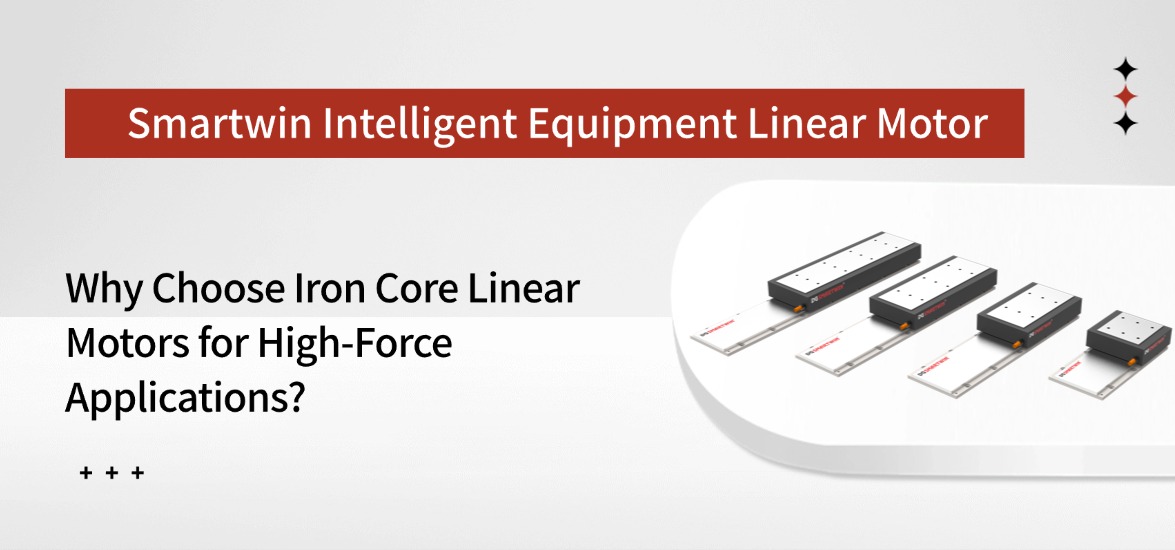
In this article, we will explain why iron core linear motors are suitable for high-force motion, how they differ from ironless motors, and how Smartwin can help you evaluate a suitable high-force direct drive solution for your machine.
Table of Contents
1.Why High-Force Applications Need Iron Core Linear Motors
2.High Force Density: The Main Advantage of Iron Core Linear Motors
3.Direct Drive Benefits for Heavy-Duty Automation Systems
4.Iron Core vs Ironless: Which Is Better for High-Force Motion?
5.Typical High-Force Applications for Iron Core Linear Motors
6.How Smartwin Supports High-Force Iron Core Linear Motor Projects
Why High-Force Applications Need Iron Core Linear Motors
High-force applications often require more than basic linear movement. When your machine needs to move heavy loads, accelerate quickly, or maintain stable force during continuous operation, traditional systems such as ball screws, belts, or gears may face limits in response speed, wear resistance, and long-term stability.
An iron core linear motor generates linear force directly, reducing the need for intermediate mechanical transmission parts. This helps improve thrust output, dynamic response, and motion stability in demanding applications.
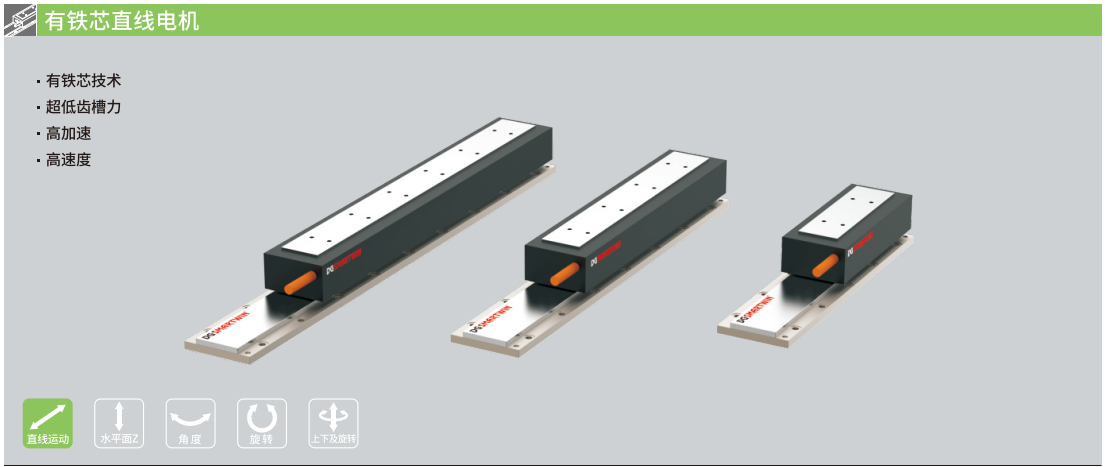
For equipment that requires heavy-duty linear motion, high acceleration, or continuous thrust, an iron core linear motor can provide a more direct and efficient drive solution.
High Force Density: The Main Advantage of Iron Core Linear Motors
1.Iron core design helps generate higher thrust
The main reason to choose an iron core linear motor for high-force applications is its force density. The iron core structure helps concentrate magnetic flux, allowing the motor to generate higher thrust in a relatively compact design.
This makes iron core linear motors especially suitable when your machine needs both continuous force and peak force. Continuous force supports stable long-term operation, while peak force helps with acceleration, deceleration, and short-time load changes.
For heavy-load axes, gantry systems, machine tools, laser equipment, and industrial automation lines, this higher thrust output can directly improve motion performance. Instead of relying on a larger mechanical transmission system, you can use a high thrust linear motor to create direct force where the machine needs it.
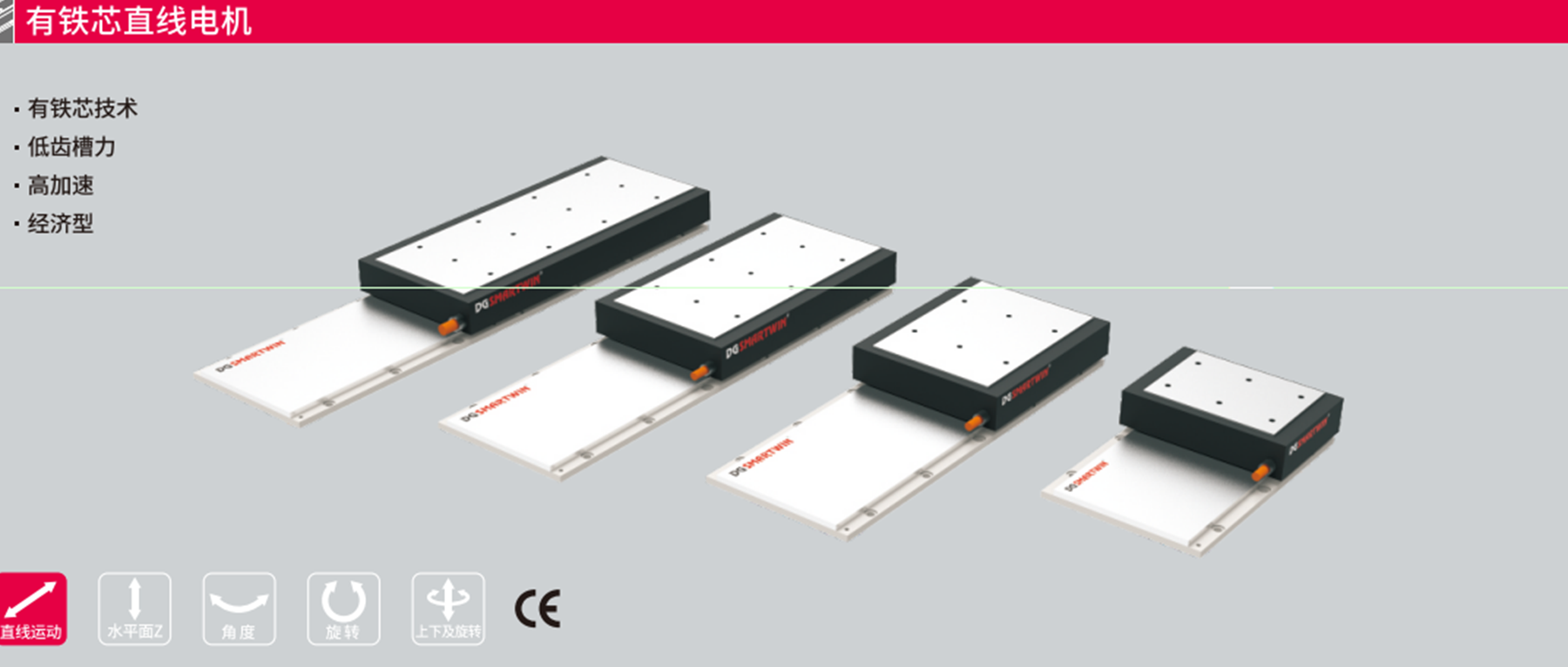
This advantage is important when your application requires:
heavy-load movement
fast acceleration under load
compact high-force structure
stable thrust output
high dynamic response
reduced mechanical transmission complexity
For your machine, the value is not only “more force.” It is stronger force in a structure that can support faster, cleaner, and more direct motion.
2.Compact high-force output supports machine design
In many industrial machines, installation space is limited. You may need higher thrust, but you may not have enough room for a larger screw system, gearbox, belt structure, or additional mechanical reinforcement.
A high force density linear motor helps solve this problem by delivering strong linear thrust in a more compact motion structure. This can be useful when you want to improve machine performance without making the entire system larger or more complex.
Direct Drive Benefits for Heavy-Duty Automation Systems
1. Fewer transmission parts reduce wear and backlash
A key benefit of a direct drive linear motor is that it removes many intermediate mechanical parts. Instead of using a motor, coupling, screw, nut, belt, pulley, or gearbox to create linear movement, the motor generates linear motion directly.
For heavy-duty automation, this can reduce common problems such as backlash, friction, mechanical wear, and transmission delay. Fewer transmission parts also mean fewer components that may need regular adjustment or replacement.
In high-force systems, mechanical wear can become a serious issue because loads are heavier and forces are larger. If the machine runs frequently, the cost of maintenance, downtime, and performance drift can increase over time.
By using an iron core linear motor system, you can reduce the dependence on contact-based mechanical transmission and improve long-term motion stability.
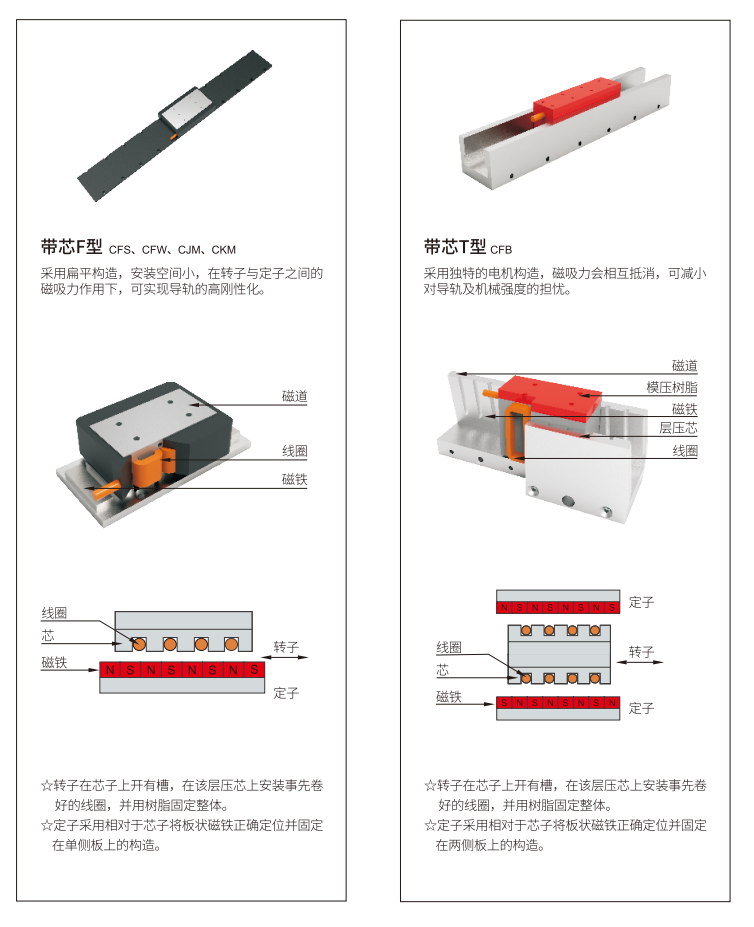
2.Faster response helps improve production efficiency
High-force applications often require more than strength. They also need speed and response.
For example, a heavy-load axis may need to accelerate quickly, stop accurately, and repeat the same motion many times per hour. If the drive system responds slowly, the entire machine cycle may be affected.
A direct drive motion system can help improve response because force is delivered directly to the moving axis. This can support faster acceleration, smoother deceleration, and better control under load.
For production equipment, this can bring practical value:
shorter cycle time
better dynamic response
improved movement under heavy load
reduced mechanical delay
more stable repeated operation
If your equipment is designed for continuous production, a linear motor for industrial automation can help improve efficiency while reducing the limitations of traditional transmission systems.
Iron Core vs Ironless: Which Is Better for High-Force Motion?
Factor | Iron Core Linear Motor | Ironless Linear Motor |
Main advantage | High thrust and strong load capacity | Ultra-smooth, cog-free motion |
Best for | Heavy loads, high acceleration, high-force output | Low vibration, lightweight, precision motion |
Force output | Higher force density, suitable for high-force motion | Lower force output compared with iron core designs |
Motion smoothness | May have some cogging force depending on design | No iron core, usually smoother at low speed |
Typical applications | CNC machines, laser processing, gantry systems, heavy-duty automation | Optical inspection, measurement equipment, laboratory automation, precision platforms |
Better choice when | Your priority is thrust, load capacity, and compact high-force output | Your priority is smoothness, low vibration, and cog-free motion |
For high-force motion, an iron core linear motor is usually the better fit. If your application requires extremely smooth low-force movement, an ironless linear motor may be more suitable.
Typical High-Force Applications for Iron Core Linear Motors
Iron core linear motors are suitable for equipment that needs strong thrust, fast response, and stable motion under load. They are often used in applications where traditional transmission systems may limit speed, force, or long-term reliability.
Application | Why Iron Core Linear Motors Fit |
CNC machine tools | Support stable thrust and precise feed motion |
Laser cutting and processing | Help achieve fast response and smooth movement |
Heavy-duty gantry systems | Provide strong force for long-stroke, high-load motion |
Industrial automation lines | Improve cycle time and reduce mechanical transmission limits |
Loading and transfer systems | Move heavy parts with direct linear force |
Semiconductor equipment | Support stable motion in high-performance automation |
Lithium battery and new energy equipment | Meet force, speed, and reliability requirements |
OEM automation machines | Offer a compact direct drive option for custom designs |
For these applications, a high-force linear motor can help simplify the motion axis and improve response under heavy-load conditions.
How Smartwin Supports High-Force Iron Core Linear Motor Projects
At Smartwin, we help you evaluate whether an iron core linear motor is suitable for your machine based on real application needs. If your equipment requires high thrust, fast response, heavy-load movement, or compact high-force output, we can review your motion requirements and recommend a practical direction.
With our professional R&D team and application experience, we help you balance thrust, speed, accuracy, structure, and long-term reliability.
If your machine requires high-force linear motion, Smartwin can help you evaluate a suitable iron core linear motor solution for your application and support better performance, reliability, and practical integration.
FAQs
1.Why are iron core linear motors suitable for high-force applications?
Iron core linear motors are suitable for high-force applications because their iron core structure helps generate higher thrust in a compact design. They are often used when machines need heavy-load movement, fast acceleration, or continuous force output.
2.What is the main advantage of an iron core linear motor?
The main advantage of an iron core linear motor is high force density. It can provide strong thrust without relying on ball screws, belts, or other mechanical transmission parts, making it suitable for heavy-duty linear motion.
3.Are iron core linear motors better than ironless linear motors?
It depends on your application. Iron core linear motors are better when your priority is high thrust, load capacity, and compact high-force output. Ironless linear motors are better for ultra-smooth, low-vibration, cog-free motion.
4.What applications commonly use iron core linear motors?
Iron core linear motors are commonly used in CNC machine tools, laser processing equipment, heavy-duty gantry systems, industrial automation lines, loading systems, semiconductor equipment, lithium battery equipment, and OEM automation machines.
Back To List